
‘Ophiuchus’ (2025) is a piece for The Busy Drone and two melodic instruments, written with the support of Orgelpark Amsterdam. It will be premièred at Orgelpark on 24 January 2026 by Wilma Pistorius (cello) and Anne Veinberg (organ), together with the wonderful self-playing organ The Busy Drone. The piece will be performed again a year later at the same venue, on 23 January 2027 by Anna Stegmann (recorder) and Jorge Jimenez (violin).
The piece is inspired by the constellation Ophiuchus, the unrecognised thirteenth Zodiac sign.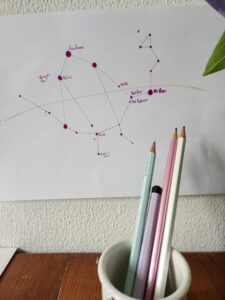
The Zodiac is defined as star constellations that the sun moves through. Though the Zodiac uses twelve star signs, the sun actually passes through a thirteenth constellation: Ophiuchus, the serpent bearer.
This star sign speaks to my imagination: as a 13th Zodiac sign, it fits better into the lunar calendar (with approximately 13 months) than the solar. I would thus call it a “lunar Zodiac sign”. Adding to its mystery, Ophiuchus is usually in the daytime sky, and often not visible from most latitudes, except for the Arctic during winter, and the Equator. Also, the constellation of Ophiuchus straddles the celestial equator (an imaginary projection of the earth’s equator into space), thus appearing to be a figure that moves between worlds.
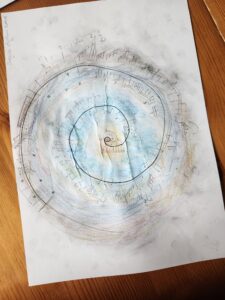
The “figure” of Ophiuchus is that of a man grasping a serpent. In Greek mythology, it represents Asclepius, the god of medicine. He is depicted holding a serpent, a symbol of renewal. To honour the serpent in ‘Ophiuchus’, I used a cyclical form with material that keeps returning.
However, the figure of Asclepius the serpent collector is a very cis-heterosexual male image, and a figure I cannot relate to as a queer woman and passionate feminist.
Fortunately, ‘Asclepius’ also has a different meaning: it is also the title of a Hermetic text, attributed to the legendary Hellenistic figure Hermes Trismegistus, who is a syncretic combination of Hermes and Thoth.
Hermes is the ancient Greek messenger of the gods, who moves freely between worlds of mortal and divine, and guides souls to the afterlife. In essence, he is a figure who moves between worlds.
Thoth is the ancient Egyptian god of the moon, wisdom, knowledge, science, art, and magic. He connects to the idea of a lunar Zodiac sign, and the whole field of understanding stars in the first place.
Thus, I took the liberty to making Hermes Trismegistus the figure of my 13th Zodiac sign, Ophiuchus (instead of the Greek god Asclepius). He is a liminal being, moving between worlds, occupying both sides, straddling the threshold – just as the star constellation Ophiuchus straddles the celestial equator. What Hermes Trismegistus represents, is the poetic essence of the piece: ambiguity, mystery, fluidity, and contradiction. This is also consonant with the idea of a lunar Zodiac sign (because it is the 13th Zodiac), that is usually (not) “visible” in the daytime sky.
The constellation of Ophiuchus contains 13 named stars. I translated four of these into important musical material, for the mose important musical themes.
- Rasalhague is the brightest star in Ophiuchus. The name is Arabic for ‘head of the serpent collector’. In my way of writing, I often make graphic scribbles that I translate into music. I translated the Arabic writing of ‘Rasalhague’ into a melody, the most important theme of the piece.
- Barnard’s Star is the star with the largest proper motion. Proper motion is an astronomical concept that expresses how much a star appears to move in relation to other stars. Barnard’s Star actually moves around in the constellation Ophiuchus (as seen from Earth). The material associated with Barnard’s Star moves between sound sources during the piece.
- Kepler’s Nova appeared in Ophiuchus in 1604. It’s intriguing that it has only become part of the constellation relatively recently. The musical material associated with Kepler’s Nova only appears later on in the piece, about halfway through. The star Kepler’s Nova is a supernova: it started out very bright in 1604 (so bright that it was visible during the day for three weeks), and continues to fade with time. What we see at the moment is only remnants of the supernova. The musical material associated with Kepler’s Nova thus starts out bright (in the foreground, clearly defined) and fade each time it comes around (softer, more fragmented).
- Yed Prior/Yed Posterior is a pair or stars that form an ‘optical double’. This means that they seem to be located next to one another as seen from Earth, but are not physically related and appear double only because of perspective. For this theme, I used two melodies that coincide to create one theme. In order to strengthen the feeling of an optical illusion, this theme is in odd meter. The melodies also appear separately from each other in different parts of the piece.
In order to ‘create’ the figure of Hermes Trismegistus with these ‘stars’ (musical material), the theme of Rasalhague is inspired by the character of the Egyptian god Thoth.
The theme of Yed Prior/Yed Postrior is inspired by the character of the Greek god Hermes. Because Hermes is an ambiguous figure, this theme is in odd meter and somewhat playful, almost a dance.
These two themes are superimposed on each other at important points in the piece, to “create” the combination of Hermes + Thoth = Hermes Trismegistus. At other points in the piece, the themes sometimes alternate, overlap and/or interact, like stars orbiting each other and moving around in a constellation.
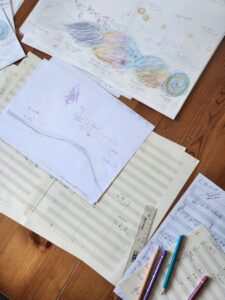
In order to create a background for these themes and loops, the piece has a musical layer of a harmonic background. This is mostly in the Busy Drone part and sometimes joined by the instruments to create more depth. The harmonic background undergoes a “progression”, not as much a progression of individual chords, but rather a progression of clouds of colours/harmonies. The progression of “pitch colour clouds” is based on the succession of the following images:
- Stars in the daytime sky, a bright sound field with a sense of mystery and ambiguity
- The southern hemisphere night sky, a vivid image in my mind, from spending gloriously dark nights in the mountains in South Africa as a child
- Dark Horse Nebula, a deep sky object in the constellation of Ophiuchus
- Pipe Nebula, a deep sky object in the constellation of Ophiuchus
- Little Ghost Nebula, a deep sky object in the constellation of Ophiuchus
I translated each of these ‘images’ into pitches through an intuitive and synesthetic process. I have a form of synaesthesia that is not directly visual, but gives me a very strong association between colours and pitches. I also have a strong association between visual or perceived tensions and intervals (=tensions between notes). This allows me to make a musical “translation” of sensory information and the effect it has on my inner landscape.
0 comments on “Ophiucus for The Busy Drone and two melodic instruments”